
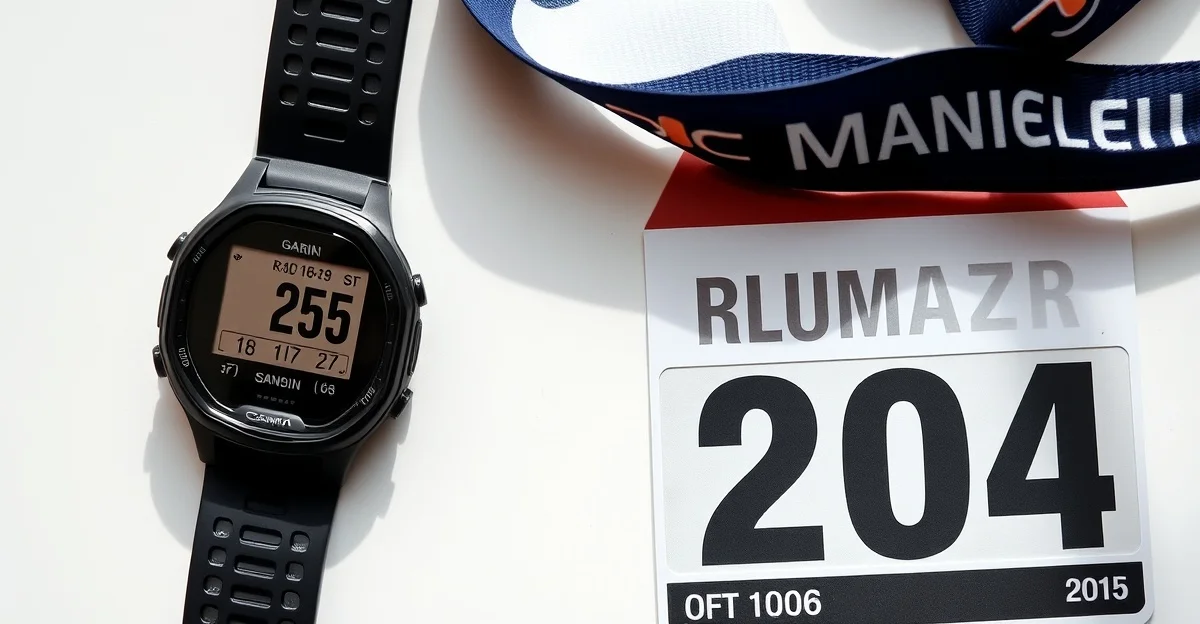

Race Data Overview
This page collects my marathon results as baseline data — the races that made the weight-to-performance correlation impossible to ignore, and ultimately led me to start a GLP-1 protocol (tirzepatide/Mounjaro). Every finish time comes from official timing. Weight is race-morning scale weight.
I started GLP-1 in February 2026, paused it after surgery on April 21, 2026 — a cycling crash that fractured my right femur and cancelled the original 2026 race plan (IM 70.3 Da Nang, Challenge Roth) — and restarted it at maintenance in early June 2026. None of the marathons below were run during the protocol — they represent the "before" picture. The "during" race data is now deferred to the road to Challenge Roth 2027.
My goal is transparency: I present both the numbers that look impressive and the ones that do not. Weight loss helps running economy, but race day is influenced by dozens of variables. I try to tease apart what changed because of weight, what changed because of fitness, and what was just weather and course conditions.
Baseline Marathon Data
All four marathons below are pre-GLP-1. I include body weight on race morning and conditions to provide context for each finish time. The pattern that emerges — faster at lighter weight — is what drove the decision to try GLP-1.
| Race | Date | Finish Time | Avg Pace | Weight (kg) | Notes |
|---|---|---|---|---|---|
| Shanghai Marathon | Nov 2024 | 3:49:47 | 5:26/km | 95.3 | First marathon at heavy training weight |
| Metropolis Marathon | Feb 2025 | 3:23:41 | 4:49/km | 92.0 | Personal best — lightest race weight |
| Berlin Marathon | Sep 2025 | 3:55:07 | 5:34/km | 92.0 | Hot conditions, pace suffered significantly |
| Valencia Marathon | Dec 2025 | 3:51:01 | 5:29/km | 95.0 | Back at heavier weight |
The standout comparison: Metropolis at 92 kg produced a 3:23 finish. Shanghai and Valencia at 95 kg produced 3:49 and 3:51 finishes — roughly 26-28 minutes slower. Berlin is the outlier: same 92 kg weight as Metropolis but a 3:55 finish, because conditions were hot and I paid for it in the second half.
This is observational data, not a controlled experiment. Fitness, taper quality, pacing strategy, and course profile all varied between these races. But weight was the biggest controllable variable, and the correlation was hard to ignore. When I found myself back at 96.0 kg in January 2026 despite consistent training, GLP-1 became a serious option.
HYROX Results
HYROX is a particularly interesting test case because performance depends on both running speed and functional station strength. Weight loss should help running splits but could compromise strength-dependent stations like sled push, sled pull, and wall balls. The station-by-station breakdown is in my guide to the eight HYROX stations, and the fueling side is in the HYROX nutrition strategy.
I have not yet raced HYROX during the GLP-1 protocol. HYROX race data will be added as events are completed. The comparison I am most interested in: whether running split improvements from lower body weight offset any strength station losses from reduced mass. For what the finish times actually look like across divisions and age groups, see the HYROX times benchmarks.
Split Analysis
Raw finish times only tell part of the story. I do not have detailed split-by-split data with heart rate breakdowns for these races, but the overall weight-to-pace correlation across the four marathons tells a clear directional story.
Weight-to-Pace Correlation
The most striking pattern in the baseline data:
- At 92 kg (Metropolis): 3:23:41 finish, 4:49/km average pace
- At 95 kg (Valencia): 3:51:01 finish, 5:29/km average pace
- Difference: ~40 seconds/km slower at 3 kg heavier
- Over the marathon distance: ~28 minutes from a 3 kg weight difference
Berlin complicates the picture: I raced at 92 kg but finished in 3:55:07 due to heat. This is a useful reminder that weight is not the only variable. Conditions, taper quality, pacing decisions, and cumulative fatigue all play a role. The Metropolis-to-Valencia comparison is the cleanest weight signal in my data, but it is still not a controlled experiment.
Pace at Heart Rate
I do not run with a chest strap heart rate monitor or running power meter that would allow clean pace-at-HR comparisons across races. The Garmin wrist-based optical heart rate is too noisy for this kind of analysis. The marathon data gives directional evidence of the weight effect, but I cannot isolate it from aerobic fitness changes with the data I have.
For future races during the GLP-1 protocol, I plan to wear a chest strap to capture cleaner heart rate data. This will allow proper pace-at-HR comparisons between pre- and post-GLP-1 race efforts.
Power-to-Weight Progression
While I do not have running power data, my cycling power-to-weight ratio provides the clearest objective measure of how the GLP-1 protocol is affecting performance output relative to body mass. FTP estimates come from Intervals.icu based on structured cycling workouts.
| Date | Weight (kg) | FTP (W) | W/kg | Change from Baseline |
|---|---|---|---|---|
| Jan 2026 (baseline) | 96.0 | 261 | 2.72 | -- |
| Feb 2026 (week 2) | 93.0 | 265 | 2.85 | +4.8% |
| Mar 2026 (week 4) | 91.0 | 275 | 3.02 | +11.2% |
| Mar 2026 (protocol end) | 92.5 | 281 | 3.04 | +11.7% |
The FTP gains are from structured cycling training (TrainingPeaks plan), not from the GLP-1 medication itself. But the W/kg improvement is amplified by simultaneous weight loss — I am producing more watts while carrying fewer kilograms. That is the compound benefit of combining structured training with body composition management.
Note: weight fluctuates daily. These are measurement-day values, not rolling averages. The 92.5 kg reading at the end of the protocol is higher than the 91.0 kg low point, which reflects normal daily variation and glycogen loading, not protocol failure.
For the full mathematical framework behind these calculations, see my race weight and power-to-weight deep dive.
Upcoming Races
The original 2026 plan was to test the protocol across two endurance events at my new GLP-1 weight. Both are off after the April 21, 2026 femur fracture — the page stays here for the record:
- IM 70.3 Da Nang — May 10, 2026. Cancelled. Was meant to be the first triathlon at the new weight, with bike power data, run splits, and overall pacing.
- Challenge Roth — July 6, 2026. Cancelled. Registration transferred in May 2026 to Challenge Roth 2027 (Sunday, July 4, 2027). Was the full-distance Ironman target with comprehensive bike-power and nutrition data over 9+ hours.
New target: Challenge Roth 2027. The GLP-1 protocol resumed at maintenance in early June 2026, and the drug changed on June 29, 2026: no clinic in Saigon reliably stocks tirzepatide, so the prescription moved to semaglutide (Ozempic), which is what I am on now and have been titrating up through August. So the first race data will come from a different molecule than the one that produced the baseline weight numbers above, which is worth stating before anyone compares the two. Race data will follow once I'm cleared to compete. Recovery progress lives on the Road to Ironman log.
Key Takeaways
After reviewing the baseline data, here is what stands out:
- Weight is the biggest controllable variable. Across four marathons, the clearest predictor of my finish time was race-morning body weight. At 92 kg I ran 3:23. At 95 kg I ran 3:49-3:51. That is roughly 9 seconds per km per kilogram — directionally consistent with published estimates of 3-4 sec/km/kg for trained runners, though my numbers are higher, likely because conditions and fitness also varied.
- Cycling W/kg tells a cleaner story. The bike power meter strips out pacing decisions, weather, and course profile. Going from 2.72 to 3.04 W/kg (a 12% improvement) in five weeks is significant. The FTP increase came from training; the W/kg amplification came from doing that training at a lower body weight.
- This is not a controlled experiment. I changed multiple variables simultaneously: body weight, training structure, and training volume (triathlon preparation). Clean causal attribution is not possible. I am presenting correlations and being explicit about confounding factors.
- The real data starts now. Baseline numbers establish the pattern. The upcoming races at new body weight will show whether the power-to-weight improvements translate to finish line results.
For the full protocol and journey context, return to the GLP-1 pillar page. For how I adapted fueling on race day, see my race day fueling guide.
Frequently Asked Questions
Does GLP-1 medication (Ozempic, Wegovy, Mounjaro) directly improve race performance?
GLP-1 does not directly improve athletic performance — it is not a performance-enhancing drug in the traditional sense. Any race performance improvements come indirectly through weight loss and the resulting better power-to-weight ratio. In my baseline data, the weight-to-pace correlation across four marathons suggests the mechanism is purely biomechanical: less mass to move per stride.
How do you separate GLP-1 effects from normal training gains?
This is the hardest analytical question. I look at weight-to-pace correlations across races run at different body weights, and I track cycling power-to-weight ratio using Intervals.icu FTP estimates. No single metric is definitive — fitness, conditions, and course difficulty all varied between my marathons. I present the full context rather than claiming clean causation.
Did you set any personal records while on GLP-1?
My marathon personal best (3:23:41 at Metropolis) was set before starting GLP-1, at my lightest race weight of 92 kg. All four marathons listed are pre-GLP-1 baseline data. IM 70.3 Da Nang (May 10, 2026) and Challenge Roth (July 6, 2026) were going to be the first races at my new GLP-1 weight, but a cycling crash on April 21, 2026 fractured my right femur and ended both starts. I paused tirzepatide after surgery to heal the bone and restarted it in early June 2026 at maintenance. The first race-data window now shifts to Challenge Roth 2027.
How did your HYROX results change on GLP-1?
I have not yet raced HYROX during the GLP-1 protocol. HYROX is a unique test case because it combines running and functional fitness stations — weight loss helps running splits but could theoretically hurt strength-dependent stations like sled push and wall balls. I will add HYROX data as events are completed.
Can I expect similar race improvements on GLP-1?
Individual results vary enormously based on starting weight, body composition, training history, dose response, and adherence to muscle preservation protocols. My data is a single case study, not a prediction for your results. The power-to-weight calculations in this article can help you model potential outcomes for your own weight and fitness level.
Ready to Train Smarter?
Get personalized training zones, race predictions, and performance insights with our free calculators.
